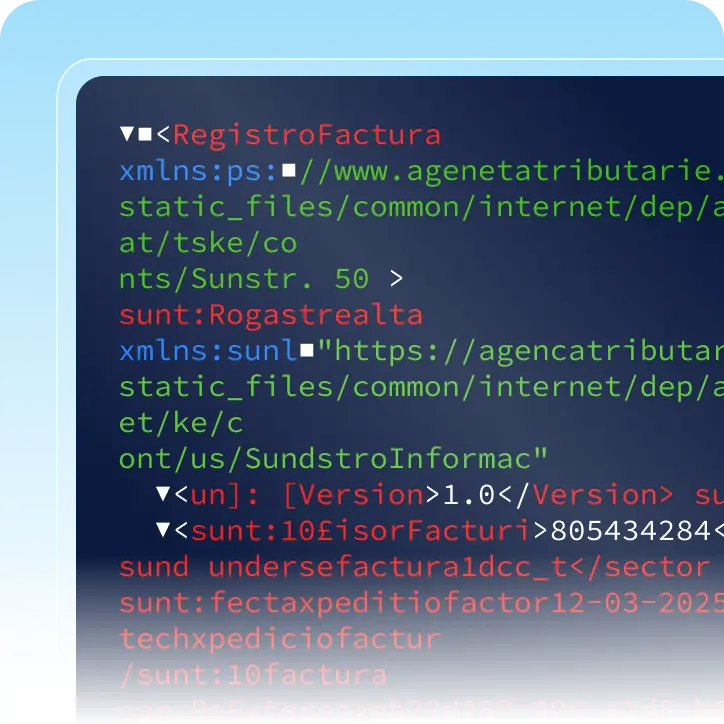
Simple and robust API to comply with the legal and technical requirements of Verifactu

Save hundreds of development hours and comply with Verifactu by integrating our API. The ideal solution for invoicing software developers and for any entity that wants to adapt to AEAT requirements through custom development. Also available for TicketBai.
alt

How our Verifactu API works

A simple API to comply with all Verifactu legal requirements.
screenshot
1
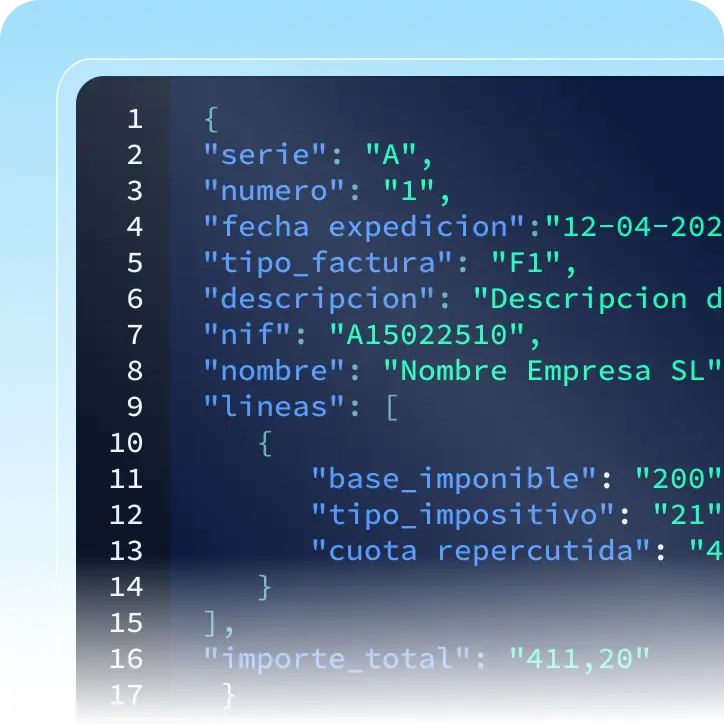
You send your invoice to our API in JSON
Send your invoice to our API in JSON format without needing a certificate. Make as many calls as you want, whenever you want.
screenshot
2
Our API returns the QR immediately
The immediate response from our API to your call includes the QR, which you can add to your invoice right away.
screenshot
3
We take care of the rest
Immediate generation of the invoicing record (XML with chain hash) and subsequent submission to the AEAT with our certificate.

Some of our clients

Antonio Tapias logo
La integración con Verifactu fue muy sencilla y el soporte ha sido excelente. Siempre atentos y rápidos para resolver dudas. Muy contento con el servicio.
Antonio Tapias
CTO & Co-Founder, Koibox
Kike Isasi logo
Hemos integrado nuestro software en tiempo record. La documentación es clara y sencilla, y los ejemplos variados y muy útiles. El equipo de soporte me ha ayudado con todas las dudas.
Sebastien Requiem logo
Verifacti's SaaS platform is intuitive and reliable, and their team's deep expertise and prompt, crystal-clear answers helped us reach our goals on time. They're not only highly knowledgeable and professional but also a genuine pleasure to work with.
Sebastien Requiem
CTO, Xolo
adminphoto
boxify
incwell
intecno
adminphoto
koibox
tfe
delagro
sts
fotostudio
epai
aldisca
agora_online
adminphoto
boxify
incwell
intecno
adminphoto
koibox
tfe
delagro
sts
fotostudio
epai
aldisca
agora_online

Your dream solution for Verifactu (and TicketBai)

An easy, secure, robust and affordable API.

Save development time

Save development time

Forget about dealing with XMLs, chaining, certificates. Send us your requests in simple JSON and save time and lines of code. We offer clear documentation and a development guide with examples to speed up your integration. 

Meet the technical requirements

Meet the technical requirements

By integrating with our API you will comply with the current and future legal requirements of the tax agency, the Anti-Fraud Law and the VeriFactu system. When you integrate with our API, your software meets the regulations and technical requirements, with the guarantee of always being up to date with new requirements. 

Easy management of permissions and certificates

Easy management of permissions and certificates

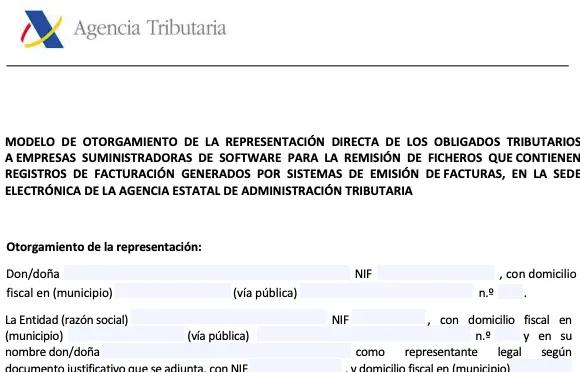
Forget about dealing with certificates. Verifacti is a social collaborator of the AEAT and we will use our own representative certificate for submitting your invoicing information or that of your users. We offer simple management of representation models via web or via API. 

Help with your responsible declaration

Help with your responsible declaration

Forget about certification processes or audits. Make a simple responsible declaration to comply with Verifactu. We provide you with a declaration draft and clarify where and how to display that declaration. 

Submission log and invoice listing

Submission log and invoice listing

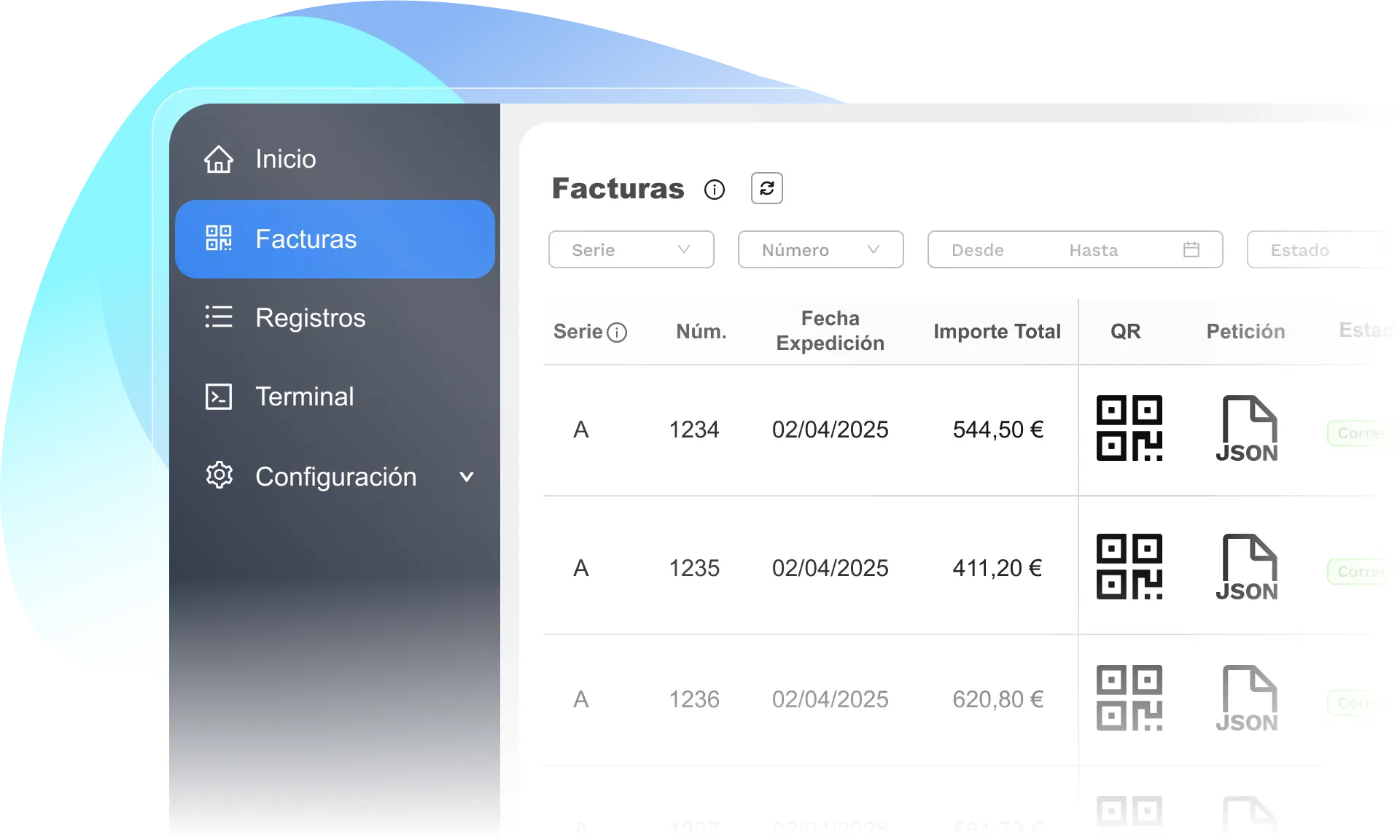
Interested in keeping the XMLs? Although the preservation of invoicing records (XMLs) is not mandatory in Verifactu mode, we store them for years and make them available for download at any time. 

Complete and simple web interface

Complete and simple web interface

Speed up your integration and streamline the verification of your invoices and submissions to the AEAT on the Verifacti web platform. You can manage NIFs, list invoices and invoicing records, access the terminal and much more. 

Minimize errors in your submissions

Minimize errors in your submissions

Our API can detect errors before submission to the AEAT. We notify you and help you correct your calls to avoid requests with errors. This way, you will save additional rectification, cancellation or amendment requests. 

Cloud infrastructure with automatic scaling

Cloud infrastructure with automatic scaling

Our API is deployed on a serverless container-based architecture, enabling automatic scaling based on load. Each request is processed in isolated environments, optimized for high availability, low latency and controlled concurrency. 

Simple integration

Save hundreds of hours of development and maintenance through a simple and clear integration with our Verifactu API.

checkmark

Simple and clear documentation

Explore our concise and clear documentation for an API with just the right endpoints needed to fulfill its mission.

See API documentation
checkmark

Integration guide with examples and executables

The information you need to facilitate your integration, including call examples and executables.

See examples
checkmark

Free account with test NIF

Do your integration at no cost with your free account that includes a test NIF to make calls to the administration's test environment.

checkmark

Dedicated support

We help our clients resolve their questions by email and phone to achieve a fast and secure integration.

Contact

A solution designed for developers

A simple and robust solution for any use case.

img

Are you a software developer?

Adapt and certify your management software effortlessly to fully comply with the Anti-Fraud Law.

checkmark

ERP manufacturer

checkmark

ERP integrator

checkmark

Invoicing software

checkmark

POS software

checkmark

PMS software

checkmark

Mobile app developer

checkmark

Technology consultancy

checkmark

Software providers

And much more

img

Do you need to adapt your own software?

If you have created your own software for your company and need to adapt it to the Anti-Fraud Law and VeriFactu, our VeriFactu API is the ideal option for your business, whether it is a small or large company.

checkmark

Adapt your own invoicing software

checkmark

Integrate your Stripe or any payment gateway

checkmark

Adapt your Shopify, WooCommerce or any online store

checkmark

Update your own ERP with your development team

And much more

Ideal solution for large clients

All the easiness and security required by software with hundreds or thousands of taxpayers.
screenshot
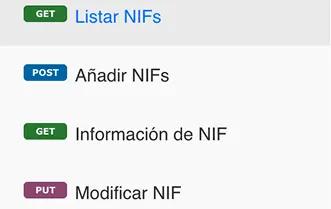
1. API for NIF management
We offer a specific API to manage NIF activations and deactivations, as well as NIF verification with the AEAT.
screenshot
2. Representation model management
Pioneering functionality to generate and manage representation models programmatically via API or from the Verifacti website.
screenshot
3. Scalable cloud infrastructure
100% cloud infrastructure, scalable and subject to periodic stress tests, ready to process millions of requests per day.
screenshot
4. TicketBai also available
Achieve TicketBai compliance through our API. We are certified software in all three Provincial Treasuries of the Basque Country.

Frequently Asked Questions

Who is the Verifacti API for?

Verifacti is a solution designed for developers and technical teams that need to adapt their software to the tax requirements established by the Agencia Tributaria (Veri*Factu) and/or the Basque Provincial Tax Authorities (Ticketbai). Verifacti is the ideal solution for:
1. Billing software vendors and distributors
Any software provider whose product includes invoicing functionality must ensure compliance with Veri*Factu and Ticketbai requirements. Software subject to compliance includes ERPs, CRMs, billing software, SaaS platforms, and in general any software that includes invoice issuance among its features.
2. Companies or self-employed individuals with their own invoicing systems.
Veri*Factu will also be mandatory for taxpayers who use their own software for issuing invoices.

Do you have a free account?

Yes. You can create an account in seconds and access a test NIF from which you can immediately make test calls to the tax authority's test environment. You will be able to complete part or even all of your integration using our free account.

Can I use Verifacti for Ticketbai?

Yes. Verifacti also helps you comply with Ticketbai. With very little additional integration work, you can meet the requirements of any of the Basque Country provincial tax authorities. TicketBai API documentation here.

How does the Verifacti API work?

The Verifacti API for Veri*Factu is designed to facilitate the submission of tax information to the Agencia Tributaria, providing an accessible solution for billing software developers. Instead of integrating directly with the tax authority's API, developers can make their requests to the Verifacti API, thus avoiding technological complexities and technical barriers.
Ease and speed
The Verifacti API is designed to offer a simple and fast integration thanks to:
  • Clear and concise documentation, with examples and Postman collections.
  • JSON as the communication format.
  • No time limits or rate limits on API calls.
  • No need for your own certificates — Verifacti uses its own representation certificates.
  • Dedicated technical support, especially during the integration phase.
The Verifacti API workflow follows this scheme:
  1. When a new invoice is issued in the billing software, a request is sent to the Verifacti API with:
    • An API key specific to the issuing company (taxpayer NIF).
    • A JSON payload with the invoice data (tax base, VAT, total, etc.).
  2. The Verifacti API responds immediately with a QR code in Base64 format, ready to be included on the invoice and delivered to the recipient.
  3. The Verifacti API immediately generates the invoicing record (XML file) in compliance with all requirements (immediacy, chaining, format, unalterability, integrity, traceability, etc.).
  4. Within the following seconds/minutes, Verifacti sends the information to the tax authority's API, which issues an XML response.
  5. You should confirm the AEAT response to verify whether the invoice was accepted or requires corrections:
    • this can be done via webhook
    • or by making a subsequent call to the record status endpoint
Verifacti API as a faithful reflection of Veri*Factu
Verifacti has designed its API to be a faithful reflection of the tax authority's API, replicating:
  • The endpoints.
  • The structure of the calls.
  • The error messages returned by the tax authority.
This means that any error returned by the Verifacti API comes, with few exceptions, directly from the tax authority. This allows developers to identify issues using the original Agencia Tributaria messages and correct them without intermediaries.
By not acting as an interpreter of the tax authority's requirements, Verifacti ensures a transparent integration aligned with official criteria, allowing developers to focus on implementation without uncertainties.

How can I test the API and complete the integration at no cost?

Verifacti offers a sandbox or free account with a test NIF so you can try the API and complete your integration.
1. Create a free Verifacti account
Sign up for Verifacti in just a few seconds. Simply go to Verifacti, click Create Account, enter your email and a password. After this step, you will be ready to explore the platform.
2. Access the test NIF
Your free account includes a test NIF, which allows you to make calls to the tax authority's test environment. To access it:
  • Go to the Companies section.
  • Click on the test NIF to enter its dashboard.
  • This test NIF is included in the free plan and is sufficient for most Verifacti integration scenarios.
3. Make your first calls from the terminal
Inside your test NIF dashboard:
  • Click on Terminal in the side menu.
  • From here you can make calls to the different tax authority endpoints through Verifacti.
  • Select a call type from the dropdown.
  • Send the test call to the tax authority by clicking Send.
  • If you test the Create Invoice endpoint, you will receive an immediate response with the QR code ready to be placed on the invoice.
4. Explore the records section
After making a call to the Create Invoice endpoint, go to the Records section to review the request information:
  • QR code image and its associated link.
  • JSON generated in the request.
  • XML sent to the tax authority by Verifacti.
  • XML response from the tax authority.
5. Use the API key
In the Settings section, you will find the API key for your test account. Use it to make API calls directly from your own code.

What is the QR code and how do I get it?

The QR code in the Veri*Factu system is an encoded URL, unique to each invoice, hosted on the Agencia Tributaria website. This URL allows anyone to verify whether the invoice has been received by the tax authority through the Veri*Factu system. The tax authority expects all invoices issued by taxpayers subject to the Veri*Factu system to include this QR code. This way, any recipient of an invoice with a QR code can easily access the URL from their mobile device and confirm that the invoice has been reported to the Agencia Tributaria.
The QR code is generated from the following 5 invoice fields:
  • Issuer NIF
  • Series
  • Number
  • Issue date
  • Amount
When a new invoice call is made to the Verifacti API, the synchronous instant response includes the QR code in Base64 image format.

What is the Declaración Responsable (responsible declaration)?

The Declaración Responsable is a self-certification in which the invoicing software (SIF) confirms that it complies with the regulations. The "certification" requirement established by the Anti-Fraud Law (Ley Anti-Fraude, from which Veri*Factu originates) is fulfilled by this "self-certification" that each invoicing software must publish, and that the AEAT may request during an inspection.
To comply with Veri*Factu, there are no external certification or verification requirements from the AEAT. Each invoicing software simply needs to include this document, which is regulated in Chapter IV of the Orden Ministerial (Ministerial Order).
In a mixed architecture scenario such as the one resulting from using an API like Verifacti, both the invoicing software and Verifacti itself must have their own Declaración Responsable. Ours is available:There is a complete section in the AEAT FAQ about this document and its requirements. Here we highlight just two very important aspects of this document:
  1. Placement of the Declaración Responsable - It must be visible to the software users and, if the software is commercialized, also to buyers. It is recommended to make it accessible in the help section for web-based software.
  1. Software numbering - The Declaración Responsable must reference the corresponding software number. Each provider must have a declaration for each software version number created after the entry into force of Veri*Factu. Only the current declaration, corresponding to the software version in use, needs to be available, although in case of an inspection the AEAT may request all previous ones.

How does certificate management and representation models work with Verifacti?

Verifacti uses its own digital certificate to submit information to the AEAT on behalf of third parties. The AEAT requires taxpayers to sign a representation model (modelo de representación).
Verifacti's certificate as a social collaborator
Verifacti uses its own digital representation certificate to send tax information to the tax authority on behalf of taxpayers. This eliminates the need to request certificates and passwords from Verifacti users, reducing security risks and avoiding user reluctance to share sensitive credentials. To this end, Verifacti operates within the framework of social collaboration (colaboración social), a figure that predates Veri*Factu and is widely used for many tax advisory purposes. Specifically, Verifacti has signed agreement 017 with the AEAT, created specifically to provide coverage for the social collaboration framework within the scope of Veri*Factu. Verifacti is listed (as Bilbabit SL) in the AEAT's official list of entities with an agreement.
Representation models (Modelos de representación)
Whenever it is not the taxpayer themselves who submits their information to the AEAT, the regulations require that taxpayers sign a representation model authorizing Verifacti to send tax information on their behalf. These representation models were published in the BOE in December 2024 (see Annexes I, II and III).
Verifacti offers its clients two different paths to streamline the signing of these representation models:
  1. From the Verifacti web interface, following the steps indicated in the Settings → Representation section for each NIF.
  2. Programmatically, through the NIF management API.
It is very important to note that the representation model only needs to be managed once per NIF. That is, if you want to have the same NIF registered twice in both test and production, it would be sufficient to complete this process once in test for it to also apply to the production NIF, even if the latter has not been created yet. Therefore, the recommended sequence for representation management would be:
  1. Create NIF in test
  2. Manage representation for that NIF
  3. Create NIF in production (the representation will already be managed without needing to do it again).

Is it necessary to certify or homologate my software?

There is no list of AEAT-certified software for Veri*Factu. The certification obligation established by the Anti-Fraud Law (Ley Anti-Fraude) is fulfilled through a self-certification, that is, a Declaración Responsable (see other related FAQs). Although some providers and billing software claim to be certified by the AEAT, such certification does not exist. It is a commercial strategy based on an inaccurate and even misleading claim.
In Ticketbai, the system used by the Basque provincial tax authorities, the concept of administration-certified software ("software garante") does exist. We also cover Ticketbai and we are "software garante", meaning software certified by the administration in all three provinces of the Basque Country. Here is the list of certified software in Vizcaya as an example.

What are the data retention obligations with Veri*Factu?

In Veri*Factu mode, there is no obligation to retain the invoicing records sent to the Agencia Tributaria, neither for the invoicing software nor for the taxpayer, since those records have already been submitted. The tax authority is clear on this: the obligation to retain invoicing records only exists in the non-Veri*Factu mode (No-Veri*Factu).
By invoicing records, the tax authority means the XML files that Verifacti generates from the calls received and submits to the AEAT. These are the XML request files sent to the tax authority and the XML response files from the tax authority. In Veri*Factu mode, there is no obligation to retain these files.
That said, Verifacti provides endpoints to download invoicing records for users who wish to keep them.
Export XMLs endpoint
Download XML endpoint
Additionally, Verifacti will store this information for all active NIFs in production and for a short period afterwards (see terms of use).
The above should not be confused with the obligation to retain invoices derived from the Invoicing Regulation (Reglamento de Facturación) or other tax or accounting regulations. Any obligation that the software or its users (the taxpayers) had before the Veri*Factu system appeared remains in effect. There are therefore retention obligations regarding invoices themselves, just as there were before the Veri*Factu regulations.