
Verifactu regulatory framework
Royal Decree 1007/2023, published on December 6, 2023, establishes a new regulatory framework for invoicing IT systems in Spain. This regulation, colloquially known as the "Verifactu Regulation", defines specific requirements that programs and systems supporting the invoicing processes of entrepreneurs and professionals must meet.
The legal basis of this regulation is found in the amendment of Article 29.2.j) of Law 58/2003 (General Tax Law), established by Law 11/2021 on measures against tax fraud. The main objective is to ensure that invoicing records meet criteria of integrity, preservation, accessibility, legibility, traceability, and immutability.
Main Features
Fundamental aspects of the Verifactu system:
- Creation of invoice records with standardized format and structure
- Implementation of IT security elements (chained hashes and electronic signatures)
- Inability to modify records without leaving a trace
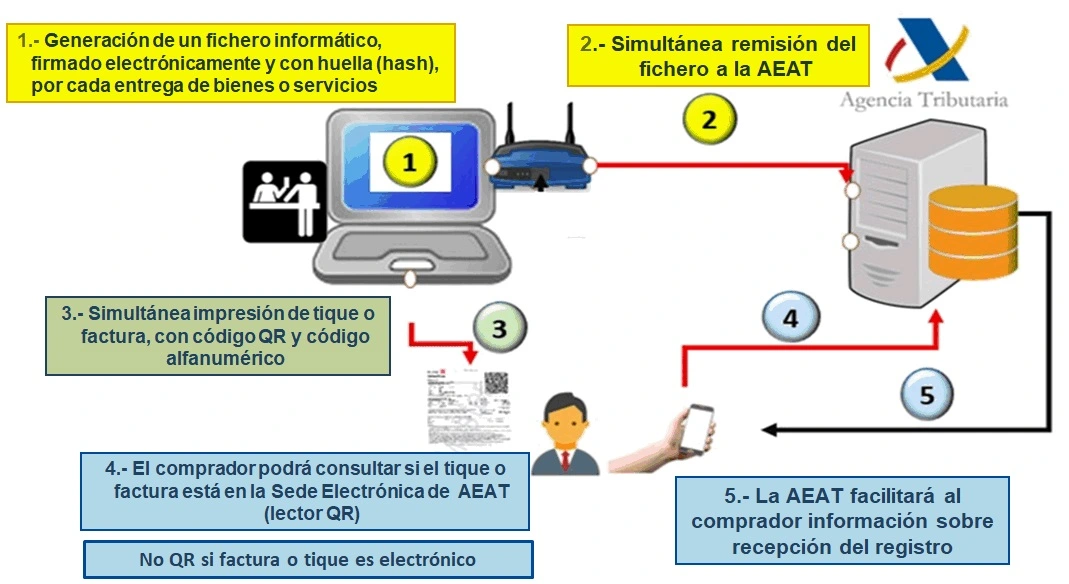
- Option to send records directly to the AEAT electronic headquarters
Expected benefits:
- Reduction of tax fraud
- Advancement in business digitalization
- Improvement in tax assistance services
- Simplification in the preparation of tax record books
Scope of Application
The regulation affects all entrepreneurs and professionals for all their operations, with the following exceptions:
- Taxpayers subject to the Immediate Information Supply (SII) system
- Subjects with no invoicing obligation
- Territories with regional tax regimes (where analogous systems such as "Ticket Bai" are already implemented)
The regulation will be applicable throughout the entire Spanish territory, except in the historical territories of Vizcaya, Guipúzcoa, and Álava, where their own invoice verification systems are in force.
Features for Clients and Taxpayers
Clients will be able to verify the tax validity of simplified invoices through queries on the Tax Agency website. This verification will be carried out through elements such as QR codes that will connect with the information recorded in the AEAT systems.
For taxpayers who use the Verifactu system with data submission, the AEAT will offer the possibility of downloading their registered operations, which will greatly facilitate accounting and tax management.
Compatibility with Other Regulations
The Verifactu Regulation is compatible with the B2B electronic invoice Regulation draft currently being processed. The IT systems of entrepreneurs must be comprehensively adapted to both regulations, using a unified data model based on the mandatory invoice references and on the established payment methods and deadlines.
Penalties for non-compliance will be regulated according to the provisions of the General Tax Law, being proportional to the severity of the infractions detected in the implementation and use of invoicing IT systems.
Chapter I: General Provisions
Article 1. Purpose and territorial scope: This article establishes that the regulation aims to govern the requirements and technical specifications that IT and electronic systems and programs used by those who carry out economic activities in their invoicing processes must meet, ensuring the integrity, preservation, accessibility, legibility, traceability, and immutability of invoicing records. The scope of application is the entire Spanish territory, without prejudice to the regional tax regimes of the Basque Country and Navarra, and the special provisions for the Canary Islands, Ceuta, and Melilla.
Article 2. Legal framework: States that the regulation is issued in development of Article 29.2.j) of Law 58/2003, of December 17, the General Tax Law.
Article 3. Subjective scope: Details the taxpayers to whom the regulation applies, including Corporate Tax taxpayers, Personal Income Tax taxpayers who carry out economic activities, Non-Resident Income Tax taxpayers with permanent establishment, and entities under the income attribution regime that carry out economic activities. It also applies to producers and marketers of invoicing IT systems.
Article 4. Objective scope: Defines that the regulation applies to invoicing IT systems used by the aforementioned taxpayers, with certain exceptions, such as taxpayers who keep the record books in the terms established in section 6 of Article 62 of the VAT Regulation.
Article 5. Request for non-application: Allows taxpayers to request the Financial and Tax Inspection Department of the State Tax Administration Agency for non-application of the regulation in cases justified by commercial or administrative practices of the sector, or to avoid disruptions in the development of economic activities.
Article 6. Delegation of compliance: Establishes that the obligation to use invoicing IT systems that comply with the regulation may be materially fulfilled by the recipient of the operations or by a third party, under the terms of Article 5 of the Regulation governing invoicing obligations.
Chapter II: Invoicing IT Systems
Section 1. Characteristics and requirements of IT systems
Article 7. IT resources necessary to comply with the obligations established in this Regulation: Indicates that taxpayers must have the necessary IT resources to comply with the obligations established in the regulation.
Article 8. Requirements for invoicing IT systems: Establishes that invoicing IT systems must guarantee the integrity, preservation, accessibility, legibility, traceability, and immutability of invoicing records. In addition, they must have an event log that automatically records certain interactions with the system, operations performed, or events that occur during its use.
Section 2. Invoicing records*
Article 9. Generation of the registration invoicing record: Establishes that invoicing IT systems must generate a registration invoicing record for each invoice issued, at the time of its issuance.
Article 10. Content of the registration invoicing record: Details the information that the registration invoicing record must contain, including data such as the Tax ID and name of the party obligated to issue the invoice, invoice number and series, date of issuance, description of the operations, total amount, among others.
Article 11. Generation and content of the cancellation invoicing record: Establishes that, in the event of invoice cancellation, the system must generate a cancellation invoicing record that contains, among other data, the identifier of the registration invoicing record being cancelled and the date and time of the cancellation.
Article 12. Hash and electronic signature of invoicing records: Provides that registration and cancellation invoicing records must include a hash and be electronically signed, unless they are submitted to the State Tax Administration Agency at the time of their generation.
Section 3. Certification of IT systems
- Article 13. Responsible declaration of IT systems: Establishes that the person or entity producing the IT system must certify, through a responsible declaration, that the system complies with the provisions of the regulation and the specifications approved by ministerial order.
Section 4. Verification of compliance with the obligation by the Tax Administration
- Article 14. Verification of compliance with the obligation by the Tax Administration: Empowers the Tax Administration to verify compliance with the obligations established in the regulation, being able to require complete and immediate access to the invoicing IT systems and to the invoicing and event records, or their secure copies.
Chapter III: Verifiable Invoice Issuance Systems
Article 15. Possibility of submitting generated invoicing records to the Tax Administration: Establishes that taxpayers may choose to submit the generated invoicing records to the State Tax Administration Agency at the time of their generation, under the terms established by ministerial order.
Article 16. Verifiable invoice issuance system: Defines the verifiable invoice issuance system as one that allows the submission of invoicing records to the State Tax Administration Agency (AEAT) at the time of their generation. The use of this system exempts from the obligation to add a hash and to electronically sign the invoicing records, provided that the technical specifications established by ministerial order are met.
Additional provisions
First additional provision. Invoicing software application developed by the Tax Administration: The AEAT may make available to taxpayers an invoicing software application that meets the requirements established in the regulation.
Second additional provision. Social collaboration in the application of taxes: The possibility is established for third parties, within the scope of social collaboration, to submit invoicing records on behalf of taxpayers, in accordance with current legislation.
Third additional provision. Integration of invoicing records in the record books: The possibility is provided for the invoicing records generated and submitted to the AEAT to be integrated into the issued invoices record books and, where applicable, into the sales and income record books.